
Optimising Parking Infrastructure for Retail Success in Preston
Practical Insights into Parking Solutions Supporting Preston’s Town Centre and Retail Destinations
Parking provision in Preston is a pivotal factor shaping the retail experience, influencing shopper accessibility, dwell time, and ultimately the commercial viability of town centre and retail precincts such as Fishergate. For procurement managers, operations directors, and plant engineers involved in managing or upgrading parking facilities, understanding the nuances of Preston’s parking environment is essential. This article draws on real-world experience and technical expertise to explore the strategic importance of parking in Preston’s retail sector, examine the types of parking facilities, and provide detailed guidance on evaluation, compliance, and cost considerations that underpin effective decision-making.
Understanding the Strategic Importance of Parking in Preston’s Retail Sector
In practice, parking is more than just a convenience for shoppers; it is a critical operational asset that directly affects retail footfall and spend patterns. Preston’s retail hubs, particularly the long-established Fishergate area, rely heavily on accessible parking to maintain competitiveness against out-of-town retail parks and online shopping alternatives. When parking capacity is insufficient or poorly managed, visitor frustration can increase, leading to reduced dwell time and lower turnover for retailers.
Preston, as a medium-sized city, experiences a complex interplay between parking supply constraints and fluctuating demand peaks. The city centre’s historic street layout limits opportunities to expand on-street parking, so multi-storey car parks and park-and-ride schemes have become integral to managing capacity. Retail destination managers and town centre planners must therefore weigh parking availability alongside customer expectations for seamless access and safety.
Moreover, operational decisions such as pricing strategies, enforcement policies, and integration with public transport hinge on a nuanced understanding of the local parking landscape. For example, the balance between short-term shopper parking and longer-term commuter parking can significantly affect turnover rates in high-street retail zones.
Varieties of Parking Facilities in Preston and Their Impact on Retail Operations
Preston’s parking provision can broadly be categorised into three main types: on-street parking, multi-storey car parks, and park-and-ride schemes. Each type presents distinct operational challenges and procurement considerations that impact retail catchment areas and shopper behaviour.
On-street parking, often metered or time-limited, serves immediate retail frontage areas but is inherently limited in capacity. Retail managers frequently face challenges in negotiating with local authorities to ensure turnover-friendly enforcement regimes. For instance, in Fishergate, stringent enforcement of on-street parking time limits has been used to deter commuter parking, thereby improving availability for shoppers. However, this requires procurement of reliable enforcement technology and clear signage to avoid customer dissatisfaction.
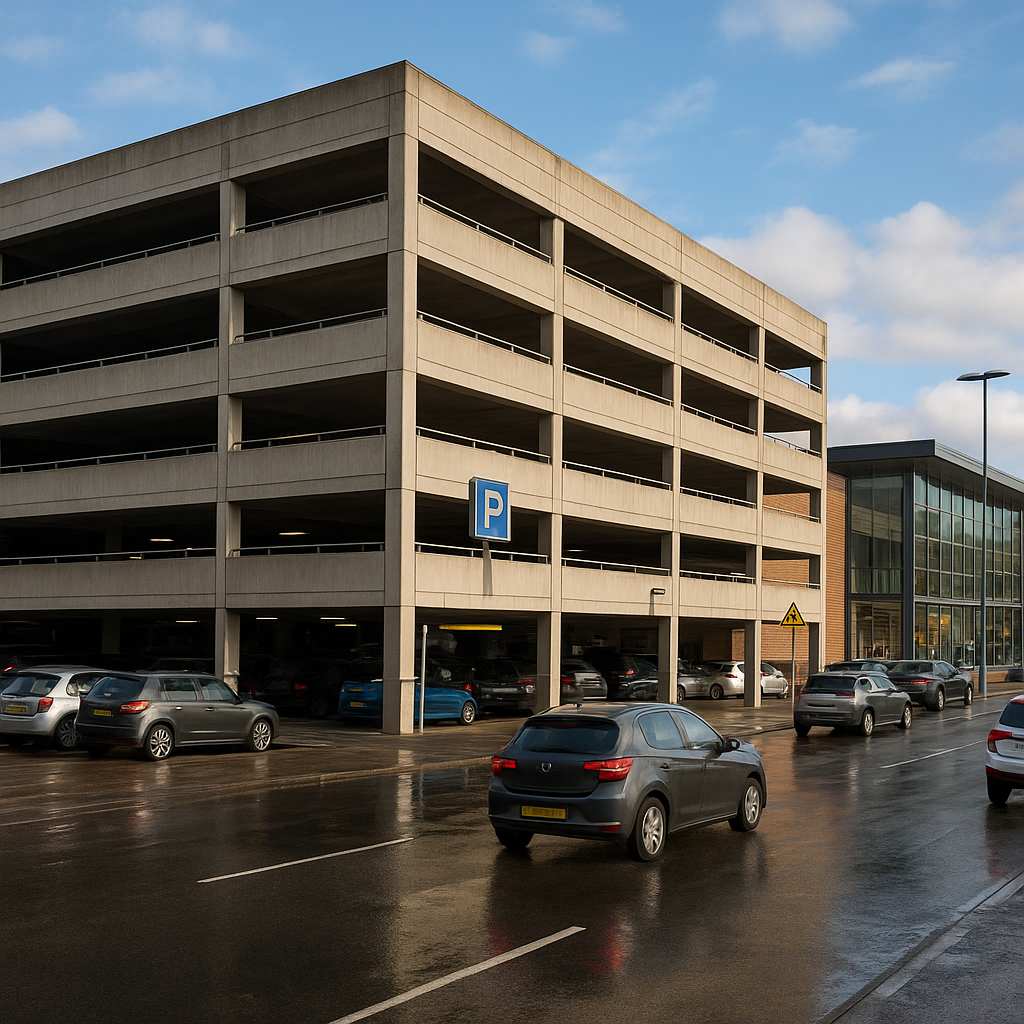
Multi-storey car parks form the backbone of Preston’s parking infrastructure, offering higher capacity close to retail concentrations. These facilities range from older structures requiring substantial refurbishment to modern installations equipped with pay-on-foot systems and real-time occupancy sensors. The choice between refurbishment and new build depends on factors including structural condition, compliance with safety and accessibility standards, and integration with digital parking management platforms. For instance, a recent procurement scenario involved a retail park in Lancashire near Preston undertaking phased refurbishment of a 500-space multi-storey car park, balancing disruption against the need to upgrade to LED lighting compliant with BS EN 12464 and install barrier systems compatible with SKIDATA ticketing equipment.
Park-and-ride schemes, typically located on the periphery of the city, are designed to alleviate central congestion and extend retail catchment areas by linking parking with public transport. Preston’s park-and-ride facilities have evolved to incorporate sustainability goals, including electric vehicle charging points and real-time occupancy updates accessible via mobile apps. Procurement in these contexts often involves coordination with multiple stakeholders, including local authorities, transport operators, and retail destination managers, to ensure capacity aligns with peak shopping periods and operational efficiency.
Critical Technical Factors to Assess When Evaluating Parking Facilities
When evaluating parking assets, technical due diligence is paramount to avoid costly oversights. Structural integrity is a key consideration, especially for multi-storey car parks exposed to variable loads and environmental factors. Buyers should commission detailed structural surveys assessing concrete spalling, water ingress, and load-bearing capacity. Ventilation systems also require scrutiny, as inadequate airflow can pose health risks and contravene safety regulations.
Compliance with lighting standards such as BS EN 12464 is another essential technical factor. Proper illumination enhances security and user experience, reducing liability risks for retail operators. Similarly, accessibility must be evaluated against BS 8300 requirements to ensure facilities accommodate users with disabilities, including appropriate ramp gradients, tactile paving, and designated parking bays.
Practical inspection criteria extend to signage clarity, which directly impacts traffic flow and user satisfaction. In Preston’s historic retail areas like Fishergate, signage must balance functional clarity with aesthetic sensitivities. Surface conditions, including pothole presence and drainage efficiency, affect safety and maintenance costs. Entry and exit flow management should be tested for congestion points, with systems evaluated for compatibility with automated ticketing or barrier controls. Finally, security provisions such as CCTV coverage, emergency call points, and adequate staffing levels must be verified to mitigate theft or vandalism risks.
Evaluating Long-Term Value: Total Cost of Ownership in Preston Parking Assets
Procurement decisions must consider total cost of ownership (TCO) rather than focusing solely on initial capital expenditure. In Preston, buyers frequently overlook the implications of maintenance cycles, spare parts availability, and refurbishment costs when assessing parking infrastructure.
For example, retaining an ageing barrier system from a manufacturer no longer supported locally can lead to elongated lead times for replacement parts, increasing downtime and operational disruption. Brands such as TIBA and SKIDATA are well-known for their extensive service networks, which is a critical factor when selecting new equipment. Similarly, ticket machines and pay-on-foot terminals demand regular software updates and hardware servicing to maintain reliability.
Efficiency trade-offs between older and modern parking assets are also significant. While older car parks might have lower upfront costs, they often incur higher energy consumption and maintenance expenses. Upgrading to LED lighting, installing sensor-based occupancy monitoring, and integrating with mobile payment platforms can reduce operational costs and improve user satisfaction. These investments, however, require careful financial modelling to justify against potential increases in parking revenue and customer retention.
Navigating Regulatory and Compatibility Challenges in Preston’s Parking Environment
Local authority regulations heavily influence parking provision in Preston, particularly concerning zoning restrictions and emission-based policies. Retail destinations within the Fishergate area must comply with restrictions aimed at reducing congestion and air pollution, such as limiting parking durations and encouraging low-emission vehicles through designated bays.
Accessibility mandates also pose practical challenges, especially for retrofitting historic car parks. Compliance with BS 8300 and the Equality Act 2010 requires modifications that can be costly and technically complex, including installation of lifts, wider bays, and improved signage. Procurement managers must factor these requirements early in project planning to avoid scope creep and budget overruns.
Compatibility issues arise when integrating third-party parking management systems with existing town centre infrastructure. For example, a procurement scenario involving a local authority’s upgrade of pay-on-foot systems encountered difficulties aligning new SKIDATA hardware with legacy software platforms controlling traffic barriers and enforcement cameras. Successful integration demands thorough technical audits and collaboration between vendors to ensure seamless operation.
Real-World Procurement Scenarios Illustrating Parking Challenges in Retail Destinations
One scenario encountered regularly involves a mid-sized retail park near Preston that required phased refurbishment of its multi-storey car park. The challenge was to upgrade lighting to meet BS EN 12464 standards, install modern pay-on-foot ticketing machines compatible with SKIDATA systems, and improve accessibility features without disrupting peak shopping periods. The project was staged over 18 months, with careful coordination between contractors, retail tenants, and local authorities to maintain operational continuity and compliance.
Another example concerns a chain of supermarkets in Preston negotiating contracts for on-street parking enforcement equipment. Their objective was to improve turnover by deploying advanced enforcement cameras and pay-by-phone systems. The procurement process involved detailed evaluation of system accuracy, data security compliance, and integration with existing municipal parking databases. The result was a measurable increase in parking turnover and customer satisfaction.
A third scenario relates to a local authority’s park-and-ride expansion supporting Preston’s retail footfall. Balancing cost, capacity, and sustainability, the project incorporated electric vehicle charging infrastructure and real-time occupancy monitoring. Procurement had to align with council emission reduction targets while securing vendor partnerships capable of delivering scalable technology solutions with acceptable lead times.
Common Queries from Operations and Procurement Leaders Regarding Preston Parking
How do parking facility types influence shopper behaviour and retail turnover in Preston’s busy town centre areas?
Parking facility types shape shopper behaviour through accessibility, convenience, and perceived security. On-street parking, while convenient, often limits dwell time due to time restrictions, encouraging quick visits rather than extended shopping. Multi-storey car parks provide greater capacity and often longer permissible stays, supporting more extensive retail engagement. Park-and-ride schemes expand the catchment area by linking parking with public transport, attracting visitors who might otherwise avoid congested town centres. In Preston, retail turnover has been positively correlated with the availability of well-managed multi-storey car parks near key shopping streets like Fishergate.
What technical inspections are essential before commissioning a new or refurbished parking asset to avoid costly downtime?
Essential inspections include structural assessments to verify load-bearing capacity and detect material degradation, ensuring the facility can safely support anticipated vehicle volumes. Electrical and lighting systems must be tested for compliance with BS EN 12464 to guarantee adequate illumination. Functional testing of ticketing machines, barrier controls, and payment systems is critical to prevent operational failures. Accessibility audits against BS 8300 standards are necessary to certify compliance and user safety. Finally, security systems including CCTV and emergency communications should be verified for coverage and reliability to protect users and assets.
How does total cost of ownership affect decision-making between refurbishing ageing car parks versus investing in new smart parking systems?
Total cost of ownership encompasses initial capital outlay, ongoing maintenance, energy consumption, and potential revenue impacts. Refurbishing ageing car parks may appear cost-effective initially but can incur escalating maintenance costs, higher energy bills due to outdated lighting or ventilation, and possible revenue losses from system downtime. Conversely, investing in new smart parking systems entails higher upfront costs but can deliver long-term savings through improved operational efficiency, reduced staffing needs, and enhanced customer satisfaction. Procurement decisions in Preston’s retail context often hinge on detailed TCO analyses that model these factors over a 10 to 20-year horizon.
What regulatory compliance aspects are most frequently overlooked in parking projects within historic or conservation areas like Fishergate?
Commonly overlooked compliance aspects include accessibility requirements mandated by BS 8300 and the Equality Act 2010, particularly when retrofitting older structures where physical constraints limit modifications. Additionally, environmental regulations concerning emissions and sustainable transport modes are sometimes neglected, resulting in penalties or retroactive adjustments. Signage and lighting standards, which must balance safety with heritage preservation, are also frequently underestimated in project planning. Early engagement with local planning authorities and heritage bodies is essential to navigate these challenges effectively.
Drawing Together Practical Insights for Optimising Parking Provision in Preston Retail Settings
Effective parking solutions in Preston’s retail environments require a nuanced understanding of how facility types, technical criteria, and long-term operational costs interrelate to influence shopper behaviour and retail performance. Multi-storey car parks, on-street parking, and park-and-ride schemes each serve distinct functions within the city’s parking ecosystem, demanding tailored procurement strategies that reflect their respective operational contexts. Technical inspections and compliance with standards such as BS EN 12464 and BS 8300 are not mere formalities but critical safeguards that protect investment value and user safety.
Procurement managers and operations directors must look beyond initial expenditure, incorporating total cost of ownership analyses that factor in maintenance, refurbishment, spare parts availability, and technology integration challenges. Balancing these financial considerations with evolving regulatory frameworks and shopper expectations is key to maintaining Preston’s retail competitiveness, especially in areas like Fishergate where historic preservation and modern retail demands intersect.
For those seeking detailed, locally relevant guidance on navigating the complexities of parking provision in Preston, resources such as the dedicated Shop Fishergate parking page offer practical insights and up-to-date information tailored to the city’s retail context. Engaging with these tools can support more informed procurement decisions and ultimately enhance the retail experience for both operators and customers alike.